Friday, November 23, 2012

New Zealand Travels, Part 4

After leaving Stewart Island and Invercargill, we returned to Queenstown for one night.   From here I begin the last part of my travels in New Zealand.  After Queenstown, we stop at Mount Cook, the highest mountain in New Zealand.  This time we'll be driving along the eastern part of the Southern Alps as we head north.  We'll stop at a place called Rangitata on the Canterbury Plains.  In the past the bus would have stopped at Christchurch after Rangitata but because of the earthquake in 2010 and 2011, Stray Travel decided to skip Christchurch.  The bus will drop me off at Christchurch, however, so I will spend a couple of nights there just to get a feel for the city.  Another Stray bus will pick me up in two days and we will go on to Kaikorua, a town on the east coast of South Island, known for dolphins and whales off its coast.  After Kaikorua, we'll go north to Picton where we'll take the ferry to Wellington.  After spending the night at Wellington, I will be on the final leg of my trip from Wellington to Auckland.  I will reach Auckland on November 28th, where I will spend about 4 days before flying home on December 2nd.
The next posts will be on Mount Cook, Rangitata, Christchurch, and Kaikorua.

Stewart Island

Most tourists go from Queenstown to Milford Sound and back in 1 day.  I decided to go with Stray Travel and stay at Gunn's Camp after Milford Sound, then travel south to Invercargill.  Gunn's Camp is about 30 minutes from Milford Sound and is an old work camp built during the depression.  Invercargill is an old sealing and whaling town in the 18th and 19th centuries and is at the southern tip of South Island.  The sealing and whaling stopped because they were over-fished so the town is struggling to keep its citizens from moving to other cities in New Zealand.  
From Invercargill, we took a 1-hour ferry to Stewart Island.  The whole island is a Nature Preserve but there are about 400 residents there.  In the summer the population goes up as this is a very popular tourist spot.  There is no skydiving or river rafting that you find in other places.  Here it's mostly fishing, hiking, bird-watching, etc.  Tourists come here for a quiet time and get away from the crowd.  Therefore, tourism is the main livelihood here besides fishing.  Fishing is mostly blue cod and crayfish, which is kind of a smaller version of a lobster.  There are also some oyster farms here.
On the afternoon that we arrived at the island, a few of us hiked along the coast near the town.  The town forms only a small part of the island.  If you want a longer hike, there are trails built for hikes up to 3 days.  There are huts along the way where you can spend the night.  A couple of girls on my bus went on a 3-day hike on the island.  The island is quite big, probably about 500 square miles.

Ferry Terminal
Half-moon Bay and the Ferry Terminal in front of the town
One of the beaches along the route that we hiked
A couple of Kaka birds that don't seem to be afraid of people
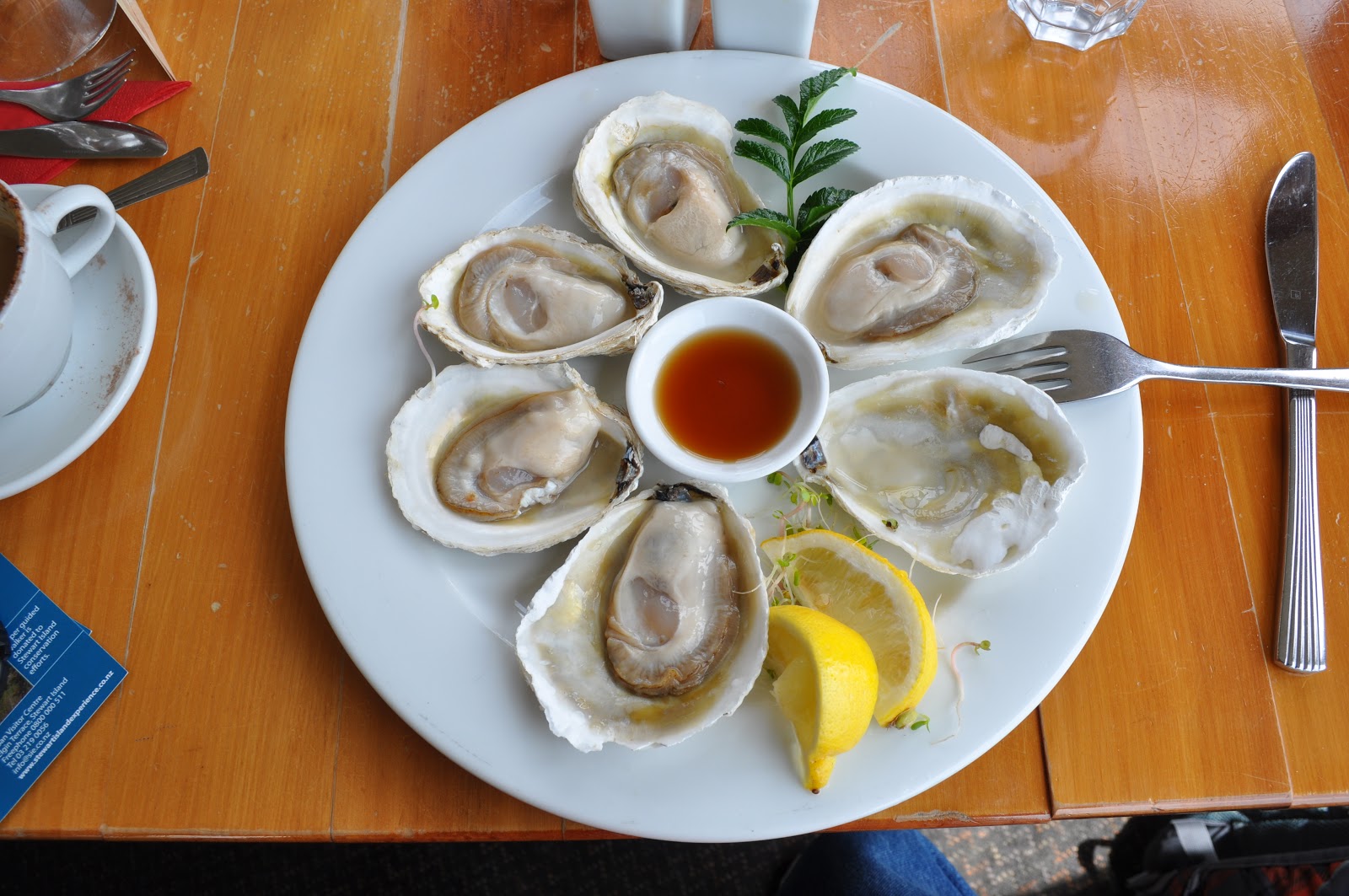
Local raw oysters, about NZ$4 each.

They have eliminated most of the animal pests that they get on North and South Islands.  The island also does not allow cats or dogs because they want to protect the birds.  At the elementary school near the ferry terminal, the kids keep a couple of sheep as pets.  Sheep are usually very shy.  Whenever our bus drives by a flock of sheep, they will run when they hear the noise from the bus.  However the 2 sheep at this school are so used to people that you can touch and cuddle them.  

"Spongeball"

The kids and Spongeball


Tuesday, November 20, 2012

Milford Sound

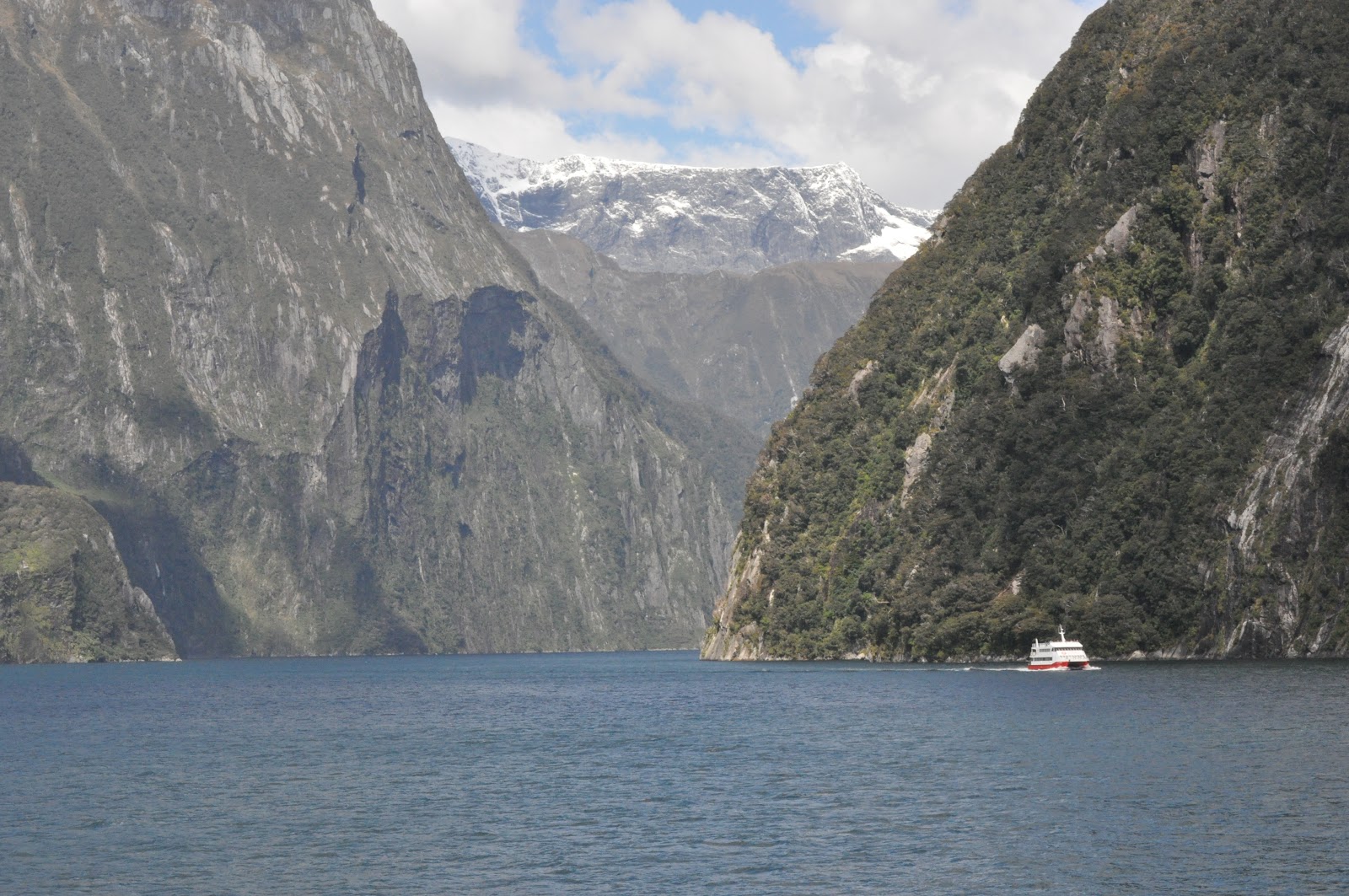
Milford Sound is probably the most popular attraction in New Zealand.  It is actually a fjord and is located in the southwest corner of New Zealand.  Many tourists come to New Zealand just to see Milford Sound and most of them use Queenstown as the base to visit the attraction.  Its most well-feature is called Mitre Peak, named because it looks like the mitre on a Bishop's hat.  It takes about 5 hours to drive from Queenstown to Milford Sound because of the mountains and lakes in between.  As the crow flies, it's only 40-50 km or about 30 miles.  There's talk about building a tunnel through the mountains but like any project of this magnitude there is a lot of opposition.
A one-day trip to Milford Sound takes about 14-15 hours, most of it on the road.  You actually spend less than 2 hours on a boat that cruise the sound.  I think the scenery along the route is just as beautiful because you pass through a whole range of beautiful and majestic mountains and lakes.  On the mountains you see endless number of waterfalls and off to the side of the road, you find trails that take you into beautiful forest and streams.
Instead of just traveling to Milford Sound and then back to Queenstown, our group stayed at a nearby camp about 30 minutes from the Sound.  This used to be a work camp during the depression but was abandoned.  They converted the huts into cabins or dormitories and added a few more buildings and built a nice lounge and kitchen.  It runs on an on-site generator, which is turned off at 10:30 pm.  Once it gets dark (right now it gets dark about 9:30 pm), you can see a full spectacle of stars in the Southern skies.  
Mitre Peak
One of many waterfalls around the Sound
A running stream along the way
A small penguin on the shore
Another view of the Sound
This is too beautiful to describe
A Kea bird.  They are not afraid of people
Mirror Lake, as you can see from the reflection
Gunn's Camp where we spent the night

Friday, November 16, 2012

New Zealand Travels, Part 3

I will be leaving Queenstown tomorrow morning, heading west towards Milford Sound.  Most tourists coming to Queenstown take a day-trip to Milford Sound.  It's a long day for a 1-day trip because the drive there takes about 5 hours.  In the afternoon we'll take a cruise around Milford Sound.  Instead of coming back to Queenstown the same evening, we are staying at nearby Gunn's Camp, a historic town.  The next morning we head south towards Invercargill/Stewart Island.  Both are at the southern tip of New Zealand.  Stewart Island is as far south as you can go without going to Antartica.  We take the ferry to Stewart Island, and after spending the night there, we take the ferry back to South Island and head back north again to Queenstown.
Then we'll start our journey back "home" to Auckland.

So, who are some of the characters on the second part of the trip?  Again, it's mostly Europeans and this time I am the only American, unless you consider Canadians as North Americans.  Canadians, however, always differentiate themselves from Americans by putting a Canadian flag on their backpacks.  I understand they don't want to be associated with the bad reputation of Americans or get mistaken by the terrorists.
We have 2 drivers on this trip, which is very unusual.  Our regular driver's name is Scratch and our backup driver is Python.  The drivers all have nicknames and these are based on something that they did or associated with.  Python is a young 24-year old, who used to drive for Stray Travel and decided to come back and drive again this summer.  He spent some time studying landscape architecture at Penn State and lived in New York City for a few months.  It's easy for me to talk to him because he knows quite a bit about the US and can relate to what I am talking about.  He grew up in Queenstown so he is very familiar with the area we've been going through the last few days.

3 high-school students studying English in Dunedin, 2 from Germany, 1 from Italy

Python, our backup driver
The group listening to a tour of town of Blackball

Queenstown

Aerial View of Queenstown
Queenstown is boringly beautiful.  If you look at the aerial view of the city above, you see mountains, snow, lake, garden (lower peninsula above), golf course (upper peninsula above), boats, restaurants, etc.  Make no mistake about it, this is a tourist town.  It is the so-called "NZ Adventure Capital."  People come here to do things, especially adrenaline activities like bunny jumpy or its cousin, the swing; jet boating; skydiving; whitewater rafting; paragliding, etc.  But you can also do more normal activities like walking, hiking, cruising on the lake, horseback riding, biking, etc.  Most tourists, however, come here to see Milford Sound, perhaps the most popular tourist attraction in New Zealand.
You find all kinds of tourists here, ranging from the lowly backpackers (like me) to the high-end tourists staying at the Hilton.  I was surprised to also find many Asian tourists, mainly from China, Japan and Korea.  Some of the shops even have sales staff speaking those Asian languages.  Many tourists also use Queenstown as a jumping point to other nearby tourist spots like Franz Josef and Fox Glaciers, Wanaka, or even to Stewart Island and Dunedin.
In town, you find a lot of bars catering to the young crowd and high-end restaurants with excellent NZ seafood, steak, lamb or venison.  I tried as much NZ native food as possible, especially seafood.  One of my favorite spots, more like a shack, sells all kinds of local seafood.  I happened to walk by there and when I looked at the extensive menu and prices, I was surprised.  One of the drivers, who grew up in Queenstown, later confirmed to me that it has one of the best seafood in town.  Another confirmation is the endless stream of customers stopping to eat there.  It is run by a big gruff Samoan, who uses the quality of his food to do the talking.  Below is a picture of the shack and the fish and chips.  My favorite are the green mussels, which are farmed in Nelson, a town that we passed through on the first day of our travel on South Island.  The mussels are big and costs only NZ$12 (about US$10) for 14.

Aggy's Shack

Green Mussels and Orange Roughy Fish (without chips)


Another specialty seafood for the west coast of the South Island is whitebait.  I forgot to mention this in my earlier posts but I tried this fish when I was at the Franz Josef Glacier village.  It's a very small fish, maybe about an inch long, white in color and usually cooked with a thin omelette patty.  I could not taste the fish itself but at least I can say I ate it.

Waterfront, where all the high-end restaurants are

Shotover Street, main thoroughfare through Queenstown


100-yr old TSS Enslaw, still running on coal

Queenstown Gardens, a beautiful park

Riding the Skyline Gondola
Another View of the Skyline Gondola

Bungy!

You can't write about New Zealand without mentioning bungy jumping.  This sport (or craze or whatever you call it) was invented here in the late 1980s'.  Since then there's been bungy jumping all over the world.
On our way into Queenstown, about 20 minutes away, we stopped at the A.J. Hackett's Bungy Center.  This is no "seat of the pants" operation.  In this building is everything you ever want to know about bungy jumping and a few steps away on the bridge, is where you can try it.  We were given a 10-minute introduction to bungy jumping - its history; commentary by one of the founders of the sport, AJ Hackett; jumps at well-known sites around the world, including the Eiffel Tower; etc.
About 10 in my travel group attempted the jump.  It costs about NZ$160.  They also have a video of you jumping that you can buy.  I have a video of someone in my group jumping but unfortunately, the video for this blog did not work after I uploaded it.
Did I jump?  No.  As in skydiving, which was offered many times on the trip, I did not jump.  I did not want to risk hurting my back.

A.J. Hacket's Bungy Center

Inside the 4-story building, a well-run center
Next to the center is the bridge for the jump

Equipment for the jump
Getting Ready

No Turning Back

Dangling above the river below

Being lowered into a rubber raft and taken to the shore

Thursday, November 15, 2012

Wanaka

We continue our journey south after leaving the Franz Josef Glacier area and then start heading towards the middle of the island.  We start to see different kinds of beautiful scenery, with snow-capped mountains in the background.  Instead of ocean and coastline, we see pastures, valleys, rivers, waterfalls, lakes and forests.  The variety is amazing and you never get bored with the greenery, water, snow on top of the mountains, animals on the farms, etc.  In order to get to Wanaka, we had to pass through Haast Pass, then through two big beautiful lakes, Wanaka and Hawea.  The two itself is next to Lake Wanaka; its setting couldn't have been more beautiful.  The mountains here are simply majestic.  It reminds me of the mountains in Switzerland and Norway.
The town itself is very small, population about 5,000.  It's a tourist town but not as well-known or touristy as Queenstown, our next stop.  Travelers come here for the peace and quiet and enjoy the abundant recreational activites here:  tramping (hiking), skiing, river-rafting, kayaking, mountaineering, rock-climbing, skydiving, fishing, etc.  Many of the activities are around the beautiful Mt Aspiring National Park area.  We spent 1 night here but with the short time that we had, we were able to just walk around the lake and town.

Pastures
Running River
Valley
Lake
Wanaka with lake and mountain in background